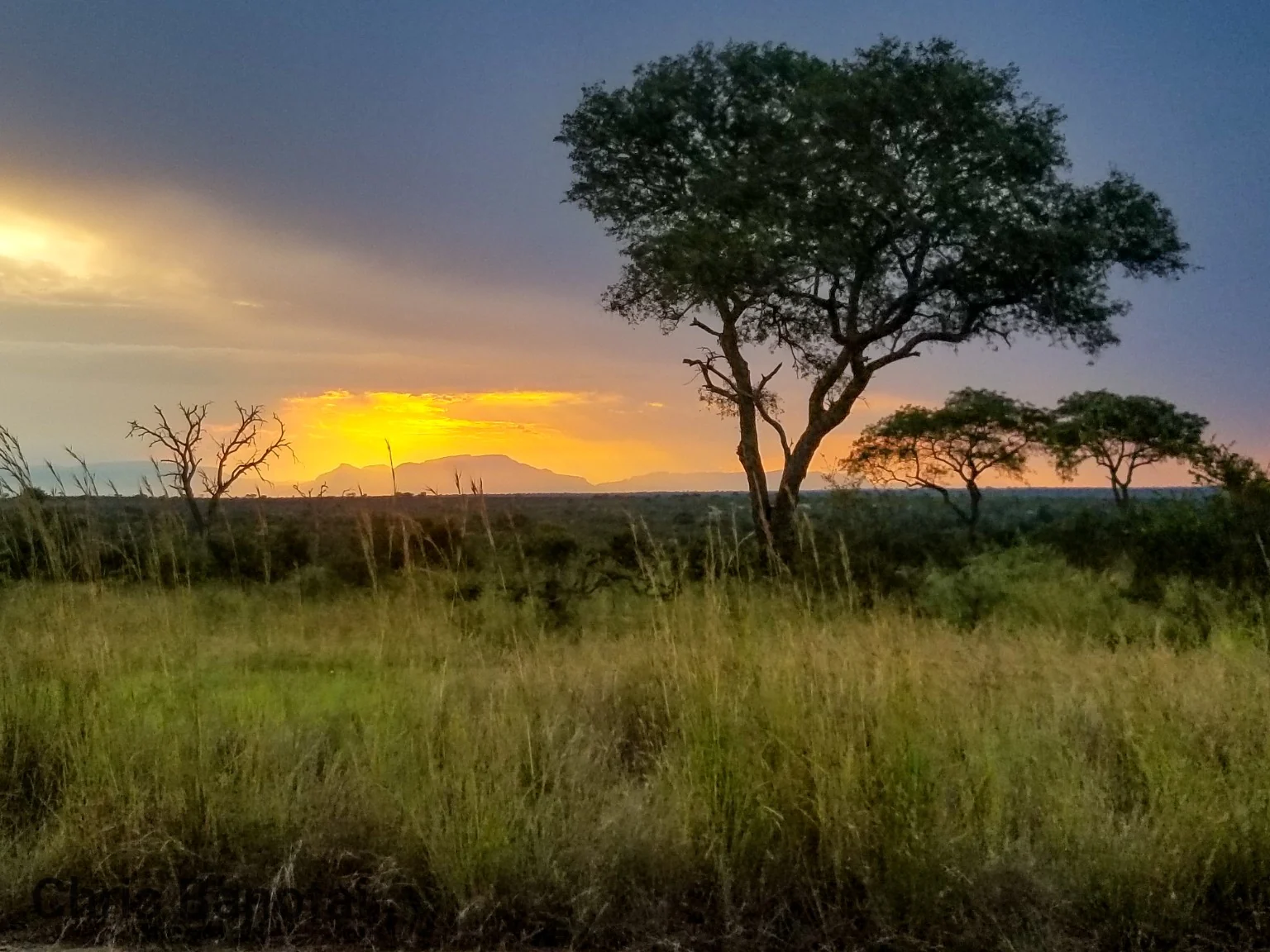
Ten years. Somehow.
I am still in a bit of disbelief that I get to share this paper.
Ten years ago, I seized a rare opportunity to see a particularly special part of the world. I had no idea how profoundly that decision would shape my life. Somewhere along the way, I fell in love with the scientific process, with living and working in the bush, and with a rather remarkable tree called marula.
Much of that journey played out in the Lowveld of South Africa, at Olifants West Nature Reserve, in the Greater Kruger Ecosystem. There were long days in the field, and longer conversations about what we had seen, what we thought we understood, and what we still had to learn. There was the particular joy of recognizing an individual mouse after catching it on successive nights, or of stopping to watch the elephants on the way home after a day's work.
And there were two Land Rovers.
There is a certain romance to a Land Rover rattling and purring its way down an African dirt road. I have been fortunate to spend a fair bit of my life doing just that. From The Rodent during my master's work to The Beagle during my PhD, these vehicles carried us through the bush and through different chapters of the same story. The questions became more complicated, the scale of the work grew, and my appreciation for the place only deepened.
Why marula?
Marula (Sclerocarya birrea caffra) is a keystone tree of southern African savannas. It provides food and shelter for wildlife, enriches the soil beneath its canopy, and holds tremendous cultural and economic value for people. Yet in parts of the Greater Kruger, mature trees are disappearing while relatively few young trees are growing up to replace them.
Elephants understandably receive much of the attention in discussions about marula decline. Their impact on mature trees can be considerable. But a tree has to survive a great deal before it ever becomes a tree large enough for an elephant to push over. The seeds have to survive, seedlings have to establish, and young trees must grow through a series of ecological challenges.
Our new paper takes a closer look at the very beginning of that journey. It asks what role some of the smaller inhabitants of the savanna might play, and what we can learn from looking at a tree and the animals around it together.
Meet the mice.
Rodents are often overlooked when we talk about the animals shaping African landscapes. Yet their lives are intimately connected to those of trees. They can consume seeds, move and cache them, and damage seedlings. Some of these interactions may help a tree; others may put an end to its life before it has really begun.
In 2014 and 2016, our team conducted controlled feeding trials using rodents and the seeds of several savanna tree species. We also grew seedlings and offered them to rodents to see what kinds of damage they could inflict.
The seed results were not as simple as a universal preference for marula. In 2014, marula seeds were handled and visibly damaged more than the alternatives. In 2016, marula seeds had lower consumption severity than knobthorn. The experiments differed in design, so we cannot treat those years as directly comparable.
The joys of gardening.
Growing seedlings for feeding trials gave us a window into a particularly vulnerable stage of a tree's life. Across four species of savanna trees, 44 of the 80 seedlings offered to rodents sustained damage that we classified as presumed lethal. That does not mean we established that 44 plants died: we did not follow their survival afterward.
What we did establish is that these small mammals are capable of inflicting substantial damage on young trees. It is a reminder that the fate of a seedling can be influenced by a creature small enough to fit in the palm of your hand.
Who walks beneath the trees?
Years later, our work took us back to the bush with a new set of questions and a great many camera traps. We monitored 20 study sites across seven vegetation communities, looking at how antelope used the landscape and searching for marula seedlings.
There is a particular pleasure to reading the signs left behind on a trail and choosing a spot to set a camera. You never quite know what you are going to find when you return to retrieve the images.
Our cameras recorded seven focal antelope species: impala, kudu, nyala, bushbuck, waterbuck, steenbok and common duiker. Their patterns of site use varied, but these records describe movement past cameras on game trails, not direct measurements of browsing on individual seedlings.
The missing generation.
Across those 20 sites we documented just 14 marula seedlings in the 2019/20 wet season and 48 in the 2021/22 survey. The surveys differed in coverage and effort; these are observations, not comparable estimates of recruitment rates.
The scarcity of seedlings was a striking result. But the limited observations and unstable statistical models did not allow us to determine whether antelope site use explained that scarcity. Rather than point a finger at a particular animal, our findings show how important it is to investigate these interactions directly.
To me, this is one of the joys of science. Each answer gives us something new to understand and often more questions than we began with.
Life on the game trails
A selection from the camera-trap archive. Select any image to view it larger. Sharpe's grysbok is an additional wildlife encounter, not one of the seven focal species analyzed in the paper.
The animals behind the numbers.
It is easy to reduce animals to a row in a dataset. But one of the greatest privileges of working in the bush is getting to know the animals as living beings, each with a particular way of moving through the world. Photography has been another way for me to pay attention to those lives. Here are a few of the beautiful animals that share the marula's landscape.
Science, conservation, and everything in between.
One of the things I treasure most about our work is the way we have been able to use science to assist conservation, and conservation to assist in growing scientific knowledge. The two need not exist apart from one another. The questions we ask in the field can emerge from the very real challenges faced by those caring for wild places; what we learn can, in turn, help us make better decisions about those places.
Conserving marula means thinking beyond the mature tree. It means understanding the processes that allow a seed to become a seedling, a seedling to become a sapling, and a sapling to become one of those magnificent trees that we know and love. In doing so, we preserve and protect so much more—for nature, for people, and for all that exists in between.
And, finally, there are the people. More than a hundred individuals put time in the field to make this research possible. Far too many to thank individually here. But to Nonwane Research Station, Transfrontier Africa, and all the lost souls who found themselves harbored there at the end of the world: thank you.
What a blessing it has been to get to know people from all corners of the world, to share the work and the wonders of the bush with them, and to have called that place home. Ten years later, it is still a little difficult to believe that this paper is finally out in the world.
I hope it leaves you a little more curious about the connections between the lives around us, and the different roles each of us plays in this rather extraordinary world.
Early Recruitment Constraints in Marula (Sclerocarya birrea caffra), a Keystone Savanna Tree: Ex Situ Rodent Feeding Trials and In Situ Seedling Scarcity
Christopher M. Banotai, Christopher Farren, Whitney L. Walker, Brooke A. Barber, Craig R. Spencer, Michael K. Stokes, and John L. Koprowski.
Conservation 2026, 6(4), 137 · Published 12 November 2026 · DOI: 10.3390/conservation6040137
Read the full paper ↗Explore more research